



Best Outdoor Furniture for Florida's Hot & Humid Climate
The best outdoor furniture for Florida has to survive three things at once: UV radiation strong enough to fade a finish in a single season, humidity that sits above 70% for most of the year, and, if your property is near the coast, salt air that eats through standard hardware in months. A patio set that looks great in a showroom in Ohio can fail within two years on a Florida pool deck.
This guide walks through the materials, hardware, and warranty terms that actually separate furniture built for Florida from furniture that just got shipped there, with a focus on what changes when you're furnishing a park, a hotel, a campus, or a restaurant patio instead of a single backyard.
Table of Contents:
- What Makes Florida's Climate So Hard on Outdoor Furniture
- Materials That Actually Hold Up
- Coastal vs. Inland Florida: Does Location Change the Answer?
- Why Warranty Terms Matter More Than the Brochure
- Furniture for High-Traffic Public Spaces
- Maintaining Commercial Outdoor Furniture in Florida
- FAQs
What Makes Florida's Climate So Hard on Outdoor Furniture
Florida gets more direct UV exposure than almost anywhere else in the continental US, and it doesn't let up for months at a time. Combine that with humidity that rarely drops below 70%, and you've got conditions attacking your furniture from two directions: UV breaks down plastics, coatings, and dyes from the outside, while humidity works into seams, welds, and fastener threads from the inside. Add salt air if your property sits within a few miles of the coast, and you've got a third failure mode: corrosion that starts at the hardware and spreads from there.
If you're furnishing a backyard, a failed patio chair is an inconvenience you replace on your own schedule. If you're managing a parks department, a hotel, or a campus, it's a budget line. Furniture that fails early gets replaced on an emergency basis instead of a planned cycle, and a single corroded bench or table in a public space becomes a liability question before it becomes a maintenance one.
Materials That Actually Hold Up
Not everything marketed as "weather-resistant" is built for Florida specifically. Four categories separate furniture that lasts from furniture that doesn’t.
1. Fully Welded, Plastisol-Coated Steel
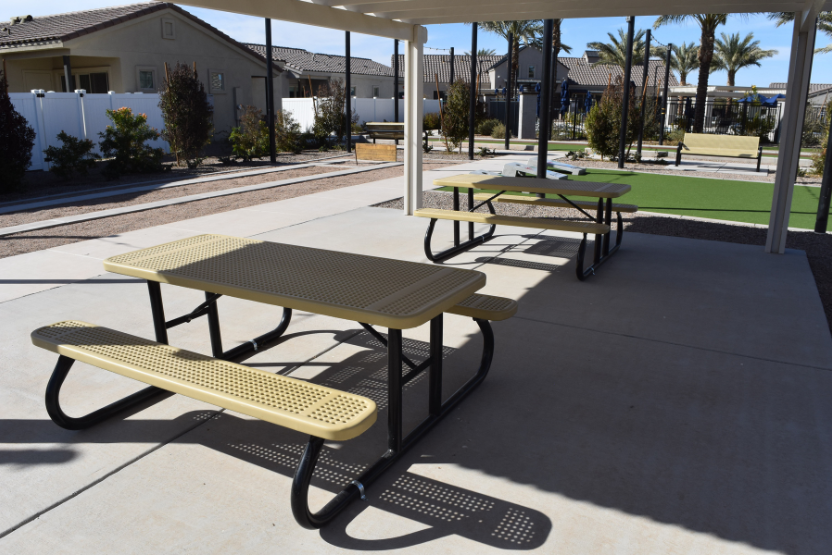
Plastisol is a thick vinyl coating that fully encases the steel frame, sealing out the moisture that causes rust before it ever reaches the metal. Look for fully welded, enclosed construction instead of bolted assembly. Bolted furniture looks identical on day one, but every joint is a future entry point for humidity, and you won't see the damage until it's already structural.
2. HDPE (Recycled Plastic)
High-density polyethylene doesn't absorb moisture, doesn't warp in humidity, and holds its color under UV exposure far longer than painted wood or standard resin. It also needs close to no maintenance, which matters once you're managing dozens or hundreds of pieces across a site. Wabash Valley's eco-friendly, recycled-plastic furniture line is built around exactly this material profile.
3. Stainless Steel Hardware
This is the detail most buying guides skip entirely. Frame material gets all the attention, but the bolts, screws, and fasteners holding a piece together are usually standard zinc-plated steel, and zinc-plated hardware is often the first thing to corrode in salt air, sometimes years before the frame shows any wear. Stainless hardware costs more upfront and outlasts the rest of the piece.
4. What to Avoid
Bare or standard powder-coated steel rusts at the weld points first, since coating rarely reaches every angle of a joint. Untreated wicker breaks down within a year or two in constant humidity. Standard resin furniture fades and turns brittle faster than HDPE because it's rarely UV-stabilized to the same degree.
|
Material / Component |
Best Use in Florida |
Florida Risk |
Maintenance Level |
|
Fully welded, plastisol-coated steel |
Parks, campuses, restaurants, hotel pool decks, high-use seating and tables |
Coating damage can expose metal if abused or cleaned harshly |
Low; mild soap and water, avoid abrasive cleaners |
|
HDPE / recycled plastic |
Pool decks, humid zones, low-maintenance public spaces |
Less design range than steel |
Very low; occasional wipe-down |
|
Stainless steel hardware |
Coastal properties and any furniture with fasteners |
Higher upfront cost |
Low; inspect during routine maintenance |
|
Teak |
Premium outdoor settings where natural wood is desired |
Higher upfront cost; needs periodic oiling |
Medium; periodic oiling required |
|
Bare or standard powder-coated steel |
Not recommended for Florida exposure |
Rusts at weld points first; coating may not reach every joint angle |
High / replacement-prone |
|
Untreated wicker |
Not recommended for constant humidity |
Breaks down within a year or two in constant humidity |
High / replacement-prone |
|
Standard resin |
Not recommended when UV exposure is intense |
Fades and turns brittle faster than HDPE |
High / replacement-prone |
Once you've settled on a frame material, how you choose the right bench material walks through the tradeoffs in more depth for seating specifically.
Coastal vs. Inland Florida: Does Location Change the Answer?
Florida's climate isn't uniform, and the material tradeoffs shift depending on where your property sits.
If you're on the coast, within a few miles of open water, you're dealing with salt-laden air that accelerates hardware corrosion regardless of frame material. Stainless hardware and marine-grade coatings aren't optional upgrades for you, they're the baseline. A finish that performs well fifty miles inland can fail within a year on a beachfront property.
If you're inland, you trade salt exposure for more direct heat and humidity. You won't face the same hardware corrosion risk, but sun exposure tends to be more constant since there's less natural shade from coastal breezes and structures. UV resistance in the coating and cushion fabric matters more for you than salt resistance does.
The practical takeaway if you're managing multiple Florida locations: a single furniture spec rarely fits a beachfront resort and an inland campus equally well. It's worth reviewing the coating and hardware grade against each site's specific exposure before you standardize an order.

Why Warranty Terms Matter More Than the Brochure
Every outdoor furniture brand claims durability. Warranty terms are where that claim actually gets tested.
Before you sign off on a purchase order, confirm a few things: whether the warranty covers coating failure specifically and not just structural defects, whether the coverage length matches how long you plan to keep the furniture in service, and whether the vendor will share their actual claim rate rather than just the warranty length printed on the page.
A long warranty period means little if the fine print excludes coating fade or rust, which are the two failure modes you'll actually run into in Florida. A vendor with a genuinely low claim rate has usually already solved the coating and hardware problems above, since a high claim rate on Florida-deployed furniture is the clearest signal a product wasn't built for this climate in the first place.
Ask for the claim rate before you ask about the warranty length. The length is marketing. The claim rate is the track record.
Furniture for High-Traffic Public Spaces
Homeowner furniture and public-space furniture face different stress tests, even in the same climate.
Your backyard patio set gets used a few hours a day by the same handful of people. A park bench, a campus table, or a hotel pool chair gets used constantly, by strangers, often without the care an owner would give their own furniture.
That difference changes what "durable" needs to mean for you: vandalism resistance, weld strength under repeated impact, and hardware that doesn't work loose after thousands of cycles instead of dozens.
ADA clearance is another consideration residential guides skip entirely. Public benches and tables need to meet specific clearance and height requirements, which narrows your options further once climate-appropriate materials are already the baseline.
If you're designing a public park or refreshing an existing one in Florida, you're solving both problems at once: furniture that survives the climate and furniture that survives the public.
Maintaining Commercial Outdoor Furniture in Florida
Even climate-appropriate materials need a maintenance routine in Florida, just a lighter one than furniture that wasn't built for the conditions.
Rinse off salt film and pollen buildup on a regular schedule, monthly if you're on the coast, quarterly if you're inland. Skip harsh solvents or abrasive cleaners on plastisol-coated steel, since they can dull or damage the coating doing the actual protective work. Mild soap and water handles most buildup without any risk to the finish.
HDPE furniture needs even less from you: an occasional wipe-down is usually enough, since the material doesn't hold onto grime the way painted surfaces do.
For a full walkthrough of cleaning schedules and products by material type, see how to clean commercial outdoor furniture.
FAQs
What's the Most Durable Material for Outdoor Furniture in Florida?
Fully welded, plastisol-coated steel and HDPE are the two most consistent performers across Florida properties. Teak holds up naturally but costs more upfront and needs periodic oiling to keep its resistance. Steel and HDPE need close to no upkeep once installed.
Does Hurricane Exposure Change What Furniture You Should Buy?
Weight and anchoring matter more than material during hurricane season. Heavier, fully welded steel pieces resist wind movement better than lightweight furniture, and many commercial pieces can be bolted to a slab for extra security during storm season.
How Often Should Commercial Outdoor Furniture Be Replaced in Florida vs. Other States?
Furniture built for the climate, coated steel or HDPE with stainless hardware, typically lasts 12 to 20 years in Florida, comparable to its lifespan elsewhere. Furniture not built for the climate, bare steel, untreated wicker, standard resin, often needs replacing in 2 to 4 years regardless of brand.
Is HDPE (Recycled Plastic) Furniture Actually Better Than Steel in Humidity?
They solve different problems. HDPE doesn't corrode at all since there's no metal to rust, which makes it close to maintenance-free. Coated steel offers more design range and typically a longer structural lifespan for heavy-use pieces like dining tables and benches. Many Florida properties use both, HDPE for high-moisture zones like pool decks, coated steel for main gathering areas.
Furniture Built for Florida's Climate
Florida's climate doesn't leave much room for furniture that's merely good enough. The combination of UV, humidity, and salt air rewards fully welded, plastisol-coated steel and HDPE over bare steel, untreated wood, or standard resin, and it punishes weak hardware faster than almost anywhere else in the country.
Wabash Valley builds its commercial outdoor furniture around exactly these requirements: plastisol-coated, fully welded steel construction with stainless steel hardware, backed by a warranty built on an unusually low claim rate instead of fine print. Worth a look before you specify furniture for a Florida property.


